
Ventilated Facade Design Conditions in Tbilisi, Batumi and Kutaisi
The three main cities differ in seismic coefficient, climate zone and corrosion exposure. The same facade system cannot be copied from one to another without recalculation.
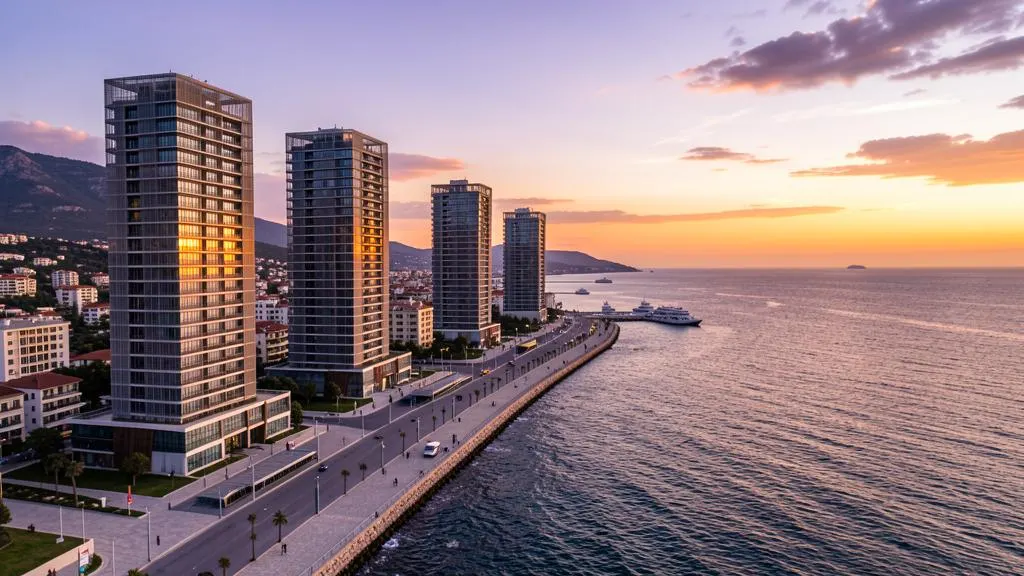
Comparison at a glance
| Parameter | Tbilisi | Kutaisi | Batumi |
|---|---|---|---|
| Seismic intensity, MSK-64 | 8 | 8 | 7 |
| Seismic coefficient A | 0.17 | 0.13 | 0.09 |
| Energy climate zone (Resolution No. 354) | Zone 2 | Zone 1 | Zone 1 |
| Wall U-value limit, W/m²K | 0.38 | 0.50 | 0.50 |
| Main exposure for the facade | Continental swings, wind on exposed sites | Humid, driving rain | Sea air, chlorides, driving rain |
Seismic values come from the regulation "Seismic-resistant construction", Annex 3 to Government of Georgia Resolution No. 71 of 15 January 2014. U-value limits are the wall limits of Government of Georgia Resolution No. 354 of 13 July 2021 for zones 1, 2 and 3 (0.50, 0.38 and 0.25 W/m²K; zone 3 is typified by Tianeti). The values are unchanged by the later amendments; as amended, the current consolidated text is on matsne.gov.ge.
Seismicity
Tbilisi and Kutaisi are both rated 8 on the MSK-64 scale, but the coefficient A is 0.17 in Tbilisi and 0.13 in Kutaisi. The inertial load on a panel and its bracket is therefore noticeably higher in Tbilisi for the same cladding weight. Batumi, at intensity 7 and A of 0.09, has the lowest seismic demand of the three, but it is not seismic-free and the cladding is still checked as a non-structural element (Article 6, paragraph 8 of the regulation).
The regulation allows the values to be refined by microzoning of the actual site, so a project on soft ground may be assigned a different intensity. The calculation method and the node principles are in seismic design of ventilated facades.
Thermal zone and insulation thickness
Batumi and Kutaisi fall in zone 1, Tbilisi in zone 2. The wall limit in Tbilisi is therefore stricter than in Batumi: 0.38 against 0.50 W/m²K. The limit applies to the wall as a whole, with the heat flow through brackets and anchors included, so the insulation thickness is not a number to copy between cities. A facade with stainless brackets and a thermal pad behaves very differently from one with plain aluminium brackets. How to count the bridges is in thermal calculation.
In the warm, humid west the problem is less the heat loss than moisture. The insulation must stay dry, the wind barrier must be intact and the air gap must drain and dry the layer behind the cladding; see air gap.
Wind and driving rain
Wind pressure and snow load for each settlement are taken from the regulation "Construction climatology", Annex 5 to Resolution No. 71. The wind pressure there is defined as a ten-minute mean at 10 m height for terrain type A, with a return period of five years, so the designer must translate it to the facade height and local exposure and state clearly how this is done. Pressure on corners and edges of the facade is higher than on its field, and cladding fixings are chosen for those zones. Details in wind and snow in Georgian climatology and structural calculation.
The same regulation gives the amount of driving rain. For Batumi and the Black Sea coast it is the data that governs the details: open joints, drip edges, sill slopes, protection of the insulation edge at window reveals and at the plinth. A rainscreen is not waterproof by design. Water gets behind the cladding, and the construction must let it out.
Marine climate in Batumi: corrosion
Salt in the air makes a coastal facade a harsher environment than the inland ones. The weak points are rarely the large profiles. They are the small parts: anchors, rivets, clips, cut edges of galvanised steel and the contact between different metals. The usual measures for a coastal project:
- subframe in aluminium alloy with anodised or coated surface, or in stainless steel; for zinc-coated steel, protection of cut edges is part of the specification;
- fasteners and rivets in stainless steel, with A4 grade in the zone close to the sea instead of A2;
- insulating washers and pads between aluminium and steel, so that no electrochemical couple is formed;
- cladding with a coating that holds up to UV and salt: PVDF-coated aluminium, HPL with UV-resistant surface, ceramic and clinker;
- drip edges and slopes at every horizontal element, so that water does not stand in a node;
- a maintenance plan: periodic washing of the surface, inspection of joints and air-gap openings.
Alloy choice, galvanic pairs and coatings are discussed in subframe profiles and alloys and the service life question in durability.
Fire: the same rules in all three cities
The fire provisions of Government of Georgia Resolution No. 41 of 28 January 2016 do not change from city to city. They depend on the building class, height and the exterior wall assembly. Above 12 m, the combustible-barrier provision of Section 1403.5 can require NFPA 285 evidence, and metal composite material cladding falls under Section 1407. The consequences for the choice of insulation and cladding are in fire strategy.
What this means for system choice
| City | Priorities in the design |
|---|---|
| Tbilisi | Highest seismic coefficient of the three; strictest wall U-value; wind exposure on hill sites; large temperature range for thermal movement of the subframe |
| Kutaisi | Seismic intensity 8 with lower A; moisture management and driving rain |
| Batumi | Corrosion class of subframe and fasteners; driving rain and drainage details; seismic check at intensity 7 |
The comparison of cladding and subframe options is in system selection.
Thermal movement and site exposure
Aluminium subframes expand and contract with the temperature of the facade surface, which on a sunlit elevation is far above the air temperature. The profiles therefore need fixed and sliding points and gaps at joints in every city; the lengths and gaps are set in the calculation from the climatology data for the site, see movement joints. Hill sites in Tbilisi, the open waterfront in Batumi and corner and parapet zones on tall buildings in all three cities need a separate look at local wind pressure, because the design values are given for a standard terrain and not for your plot.
Working in all three cities
We design for Georgian conditions using the regulations above, with Eurocodes as an agreed reference where the Georgian documents are silent, and we draw on projects in Central Asia where seismic and temperature conditions are similarly demanding. Tell us the city and the site type, and the design brief will already carry the right coefficient, zone and corrosion class. Request a calculation.