
Resolution No. 476: construction products, DoP and ETA for facade components
Government Resolution No. 476 of 2018 is the Georgian basis for demanding a declaration of performance and an ETA from the supplier of anchors, subframe and cladding. Here is what it says and how to use it in a facade project.
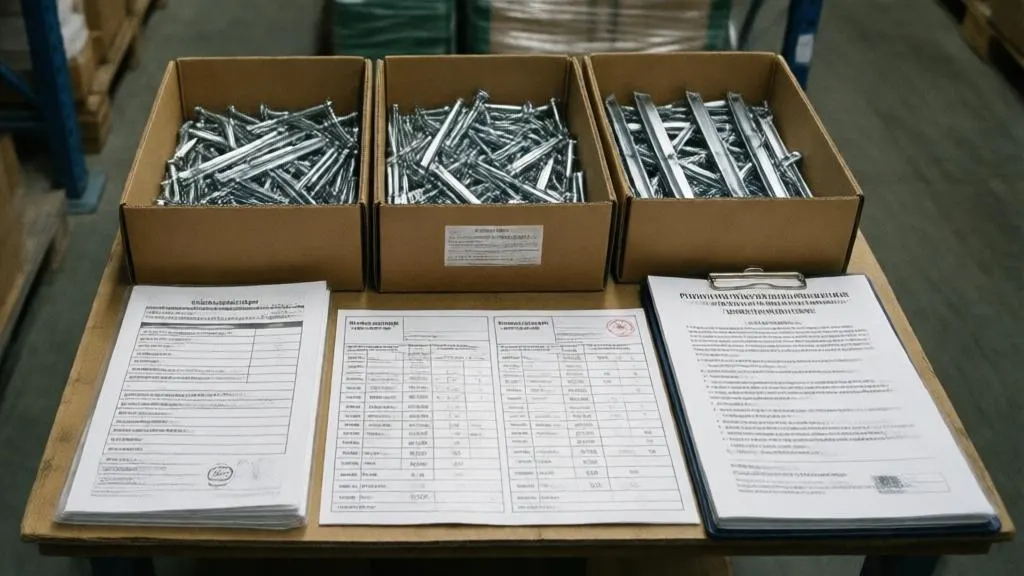
Anchors, brackets, rails, insulation and cladding panels are construction products, and in Georgia they fall under the technical regulation on construction products approved by Government of Georgia Resolution No. 476 of 1 October 2018. It has been in force since 15 November 2018. The text is on matsne.gov.ge: Resolution No. 476 (Georgian).
What the regulation introduces
Resolution No. 476 brings in two instruments that a facade designer meets on every project: the declaration of performance (DoP) and the marking of construction products. Its definitions also include the European Technical Assessment (ETA): a product is considered compliant if it meets either a Georgian standard or the requirements of an ETA.
The logic follows Regulation (EU) No 305/2011 on construction products. This is not an accident. Article 142, paragraph 10 of the Code of Georgia (No. 3213 of 20 July 2018) requires the Regulation to be taken into account when the act on construction products is prepared. The list of standards to which the regulation refers (Annex VII) is published by the National Agency of Standards and Metrology.
What this means for a ventilated facade
Georgia has no national standard for ventilated facade systems, and the regulations contain no Georgian equivalent of EAD 090062 or ETAG 034. The legally clean position is therefore this: Georgia recognises the ETA for construction products, and the EAD documents of EOTA serve as the European technical basis for subframes and anchors. For a rainscreen you build the evidence from product documents, not from a single facade code.
In practice, the designer asks the supplier of each safety-relevant component for the document set below and attaches it to the structural calculation (see structural calculation of a ventilated facade).
Document checklist for the supplier
| Component | Ask for | Why it matters |
|---|---|---|
| Anchors into concrete, masonry, aerated concrete | DoP and ETA for the exact anchor type, size and base material; characteristic resistances and edge/spacing data | The pull-out and shear values in the calculation must come from the assessment, not from a catalogue summary |
| Brackets and rails (aluminium or steel) | Declaration of performance or manufacturer declaration, alloy and temper, section properties, test report for the connection | The alloy and the section define the design resistance; see subframe profiles and alloys |
| Fasteners (rivets, screws) | Material grade, corrosion protection, ETA where the product has one | Fastener type and material are checked together with the cladding and the rail |
| Insulation | DoP with declared thermal conductivity and fire test evidence relevant to Resolution No. 41 | Feeds the thermal calculation and the fire strategy |
| Cladding panels | DoP or manufacturer declaration, fire test evidence, dimensions and tolerances | Fire evidence for metal composite and HPL follows the American test methods of Resolution No. 41 |
How the documents fit with the other regulations
- Fire: the product document does not replace the fire evidence required by Chapter 14 of the Building Safety Rules; see Resolution No. 41.
- Energy: declared conductivity of insulation feeds the wall U-value check under Resolution No. 354; see Resolution No. 354.
- Calculation: there is no Georgian regulation for aluminium structures or for anchors in concrete, so the verification normally relies on European standards; see Eurocodes in Georgia.
Typical gaps in supplier documentation
- An anchor is specified without an ETA, or the ETA covers a different base material from the one on site.
- The calculation uses resistances of a different anchor size or embedment depth from the one ordered.
- The alloy in the drawings differs from the alloy in the delivery documents.
- Substitution of a component at the shop-drawing stage without re-checking the calculation.
- Fire evidence refers to a European class only, while the Georgian regulation asks for ASTM and NFPA test results.
Questions to ask before the order
- Does the declared performance cover the base material of this building (dense concrete, solid brick, hollow block, aerated concrete)?
- Does the assessment cover the load direction used in the calculation: tension, shear and combined load?
- Is the corrosion protection suitable for the location? Coastal sites such as Batumi call for a closer look at the material grade.
- Are the documents issued for the product that will actually be delivered, with the same type designation?
The regulation does not set facade-specific values. It gives the framework (declaration, marking, recognition of the ETA) and the designer fills it with the data of the particular system.
A working procedure
- List the safety-relevant components in the specification: anchors, brackets, rails, fasteners, insulation, cladding.
- Request the DoP and, where the product has one, the ETA, before the calculation is finalised.
- Take design values from those documents and cite the document numbers in the calculation note.
- Keep the documents in the project file so that the reviewer and the site supervisor see the same set.
- Re-check the calculation whenever a component is replaced.
The regulation text and its annexes are in Georgian only. Work from the original on matsne.gov.ge and check the current consolidated version. For a facade project in Georgia, send us the drawings and the proposed product list and we will assemble the document set for the design.