
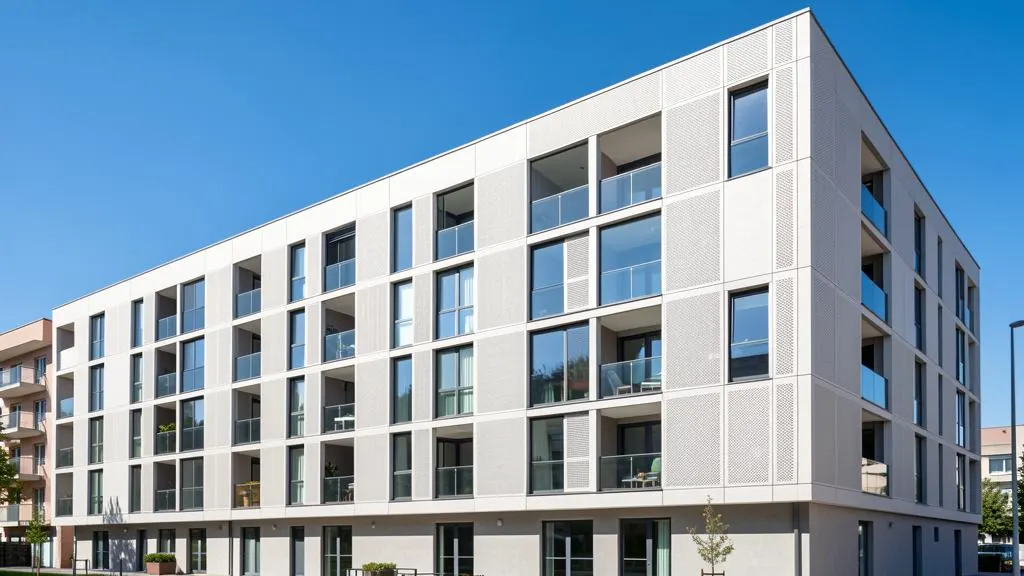
The object combines porcelain stoneware and metal cassettes on one rainscreen system. Porcelain stoneware covers the main planes. Metal covers belts, bays, technical zones and places where stone adds weight or an extra joint.
Why two materials
Porcelain stoneware gives a flat, heavy-looking plane with stable dimensions, frost resistance and colour that does not fade like a cheap paint. But it needs a subframe pitch matched to the tile format, a careful clip layout and reserve in bracket capacity. Where the plane breaks, where a thin overhang, a box or a curved bypass is needed, stone becomes more expensive and harder to install.
A metal cassette solves those places. The sheet is bent into a box and coloured either to match the stone or as a contrasting band.
The junction is the key detail
The joint between the two claddings is the main detail of the object: one guide, two modules, one ventilation gap. If the materials are designed separately, the facade ends up with a step, different projections and a gap where wind-driven snow enters. Here both circuits were supplied as one system: brackets, profiles, clips for tile, concealed fixings for cassettes, corner and reveal elements, seals.
The cassette thickness, flange and projection were selected so that its face lies in the same plane as the tile. Otherwise raking evening light draws a step along the whole length of the building.
Porcelain stoneware on a rainscreen
- Clips hold the tile by a groove or a back profile; the load goes into the guide and an air channel remains behind the tile.
- The format is chosen to avoid cutting the field into offcuts around windows: a residential facade is full of openings and every cut tile is visible.
- Residential buildings need a fire-correct build-up, fixing at floor slabs, bypasses at balconies and loggias, and sills that keep water from running into the window joint (see fire safety requirements).
- Porcelain stoneware does not insulate: heat resistance comes from the mineral wool slab, while the tile is a screen and protection.
- Fasteners, steel grades and bracket pitch are calculated for the specific wall and wind zone, not copied from the previous object (see anchors and substrates).
Where cassettes sit next to stone
Metal closes cornice boxes, friezes, technical grilles and roof abutments. The colour is a design decision: matching the stone or an architectural accent.
Result of a single specification
For a residential building the combination pays off through details: less tile cutting on broken belts, less weight on cantilevers, one ventilated channel. With two separate contractors the junction is usually repaired after handover. Here both materials were covered by one specification and one calculation.
For a similar combined facade, send us the drawings. Material options are listed in materials.